
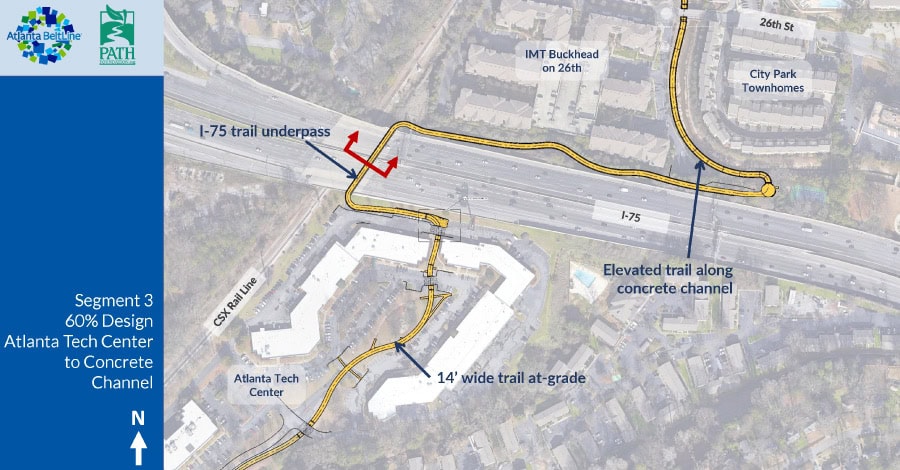
The Atlanta Beltline, an urban revitalization project focused on turning historic railway lines into public parks and multi-use paths, is getting closer to closing the 22-mile loop around the city. On Sept. 10, 2026, the Beltline began construction on a new segment of the Northwest Trail. The planned path includes a pedestrian bridge over Northside Drive and passage under Interstate 75. In between, the path will bisect the Atlanta Technology Center (ATC), a 19-acre office park owned by the Georgia Tech Foundation (GTF). In attendance at the path’s groundbreaking ceremony was the mayor, a number of councilmen, and economic development executives, showing the importance of what a completed Beltline would mean to the city: easy access to jobs, dining, and entertainment, spurred economic growth, and vibrant community spaces. But this new addition is also beneficial for GTF. With direct access to the Beltline, the area surrounding ATC becomes a desirable area to live and work, thereby enhancing the real estate investment GTF made eight years ago.
The Atlanta Beltline has Georgia Tech roots: the idea was first conceived by Tech student Ryan Gravel, who noticed that Atlanta’s abandoned railroad tracks formed a circle around the city. Because a rail line’s gradient can only be a few degrees, he saw these old lines as perfect for pedestrian and cyclist use. In his 1999 thesis, he imagined using those tracks to connect neighborhoods and job centers, and in the process, revitalize previously industrial spaces and encourage economic development.
It was a concept much needed. In the late 1990s, following two decades of growth, Atlanta was struggling with urban sprawl, a lack of public parks, and traffic congestion. It was (and still is) difficult to live in Atlanta without a car; unlike other major cities, Atlanta’s public transit doesn’t go to enough places.
But when the Eastside Trail of the Beltline opened in 2012, it demonstrated the project’s potential to alleviate the city’s growing pains, immediately becoming a popular destination for walking, jogging, and cycling.
“At the time, there were a lot of young millennials working in that area, which was very tech-centric,” says Carl Dickson, GTF’s vice president of real estate. “The access to restaurants and green spaces, and the opportunity to get out and mingle hit perfectly.”
Billions of dollars in private investment has followed the trail’s construction over the past 14 years, turning abandoned industrial sites into housing, restaurants, markets, and community spaces. As work begins on this new segment on the Northwest Trail, GTF expects the neighborhoods surrounding ATC will experience the same revitalization, adding value to the investment the organization made when it purchased the 19-acre property in 2018.
GTF President Al Trujillo and Dickson say the purchase of ATC has already proved to be a worthwhile venture. Its location, on Northside Drive close to I-75 and Atlantic Station, allows tenants to easily reach midtown, downtown, or the suburbs of the city.
Today, ATC comprises two full-service office buildings and two buildings that include a combination of office and flex space. These features have attracted growing technology companies, such as Enovis, a medtech business, and Endeavour Energy, which works to develop carbon neutral energy solutions.
Add in access to the Beltline, and office space at ATC becomes even more attractive.
“This truly does provide an opportunity for someone to build a company where those who work there can not only work, but play and live nearby,” says Trujillo. “On the Eastside Trail, you can see how people have located their work and their residence where they don’t need a car. And I think this side of the Beltline, once completed, we’ll have the same characteristics.”
Most of what has been constructed of the Atlanta Beltline today has been built on the city’s old rail lines. But because the ATC property was never on one of these lines, it has proved a more difficult segment to construct. The Atlanta Beltline, Inc. was able to acquire easement rights to construct the path through the middle of ATC, but then had to figure out how to safely get pedestrians across busy Northside Drive, where the path leaves the ATC property in its southwest corner. It was decided that a bridge over the road would be the best way to keep pedestrians safe without interrupting traffic on a major thoroughfare. At almost 100 yards, this bridge will be the longest on the Beltline.
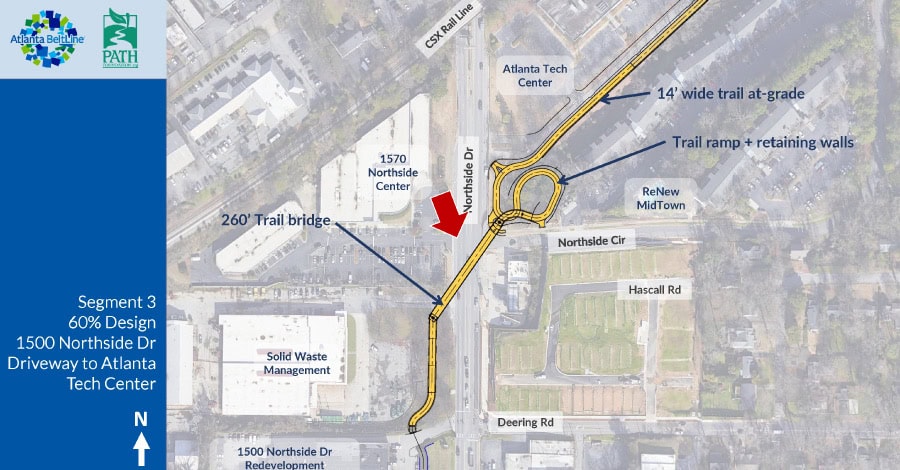
Other development is already underway in the neighborhood surrounding ATC that will benefit from access to the Beltline. To the north, the Teachers Retirement System of Georgia is building a new headquarters on 12 acres. The owners of The Grove, a taproom located where the new pedestrian bridge will land, recently bought a warehouse that they plan to turn into food and beverage space, as well as designer studios.
About 80% of the 22-mile Beltline is complete at this point. The path through ATC is one of the final pieces of the Northwest Beltline. Atlanta Beltline President Clyde Higgs expects this section to be complete in 2028 and the entire Beltline in 2030. The project has shown it’s a great resource to the city of Atlanta, but Trujillo points out it also supports Georgia Tech’s goal of building an ecosystem where young entrepreneurs, inventors, and creators will want to build organizations.
“This is a tangible example of something that will not only benefit Georgia Tech, but also the city overall,” Trujillo says. “The Beltline path enhances the value of ATC, so it’s an example of how we are doing well financially, but at the same time we are doing good for the community. For that, I think we can feel proud of this project.”